
$13.65
Add to Cart
Super Drosera Binata Dichotoma Seeds Pcs 40 Carnivorous Drosera Forked Sundew
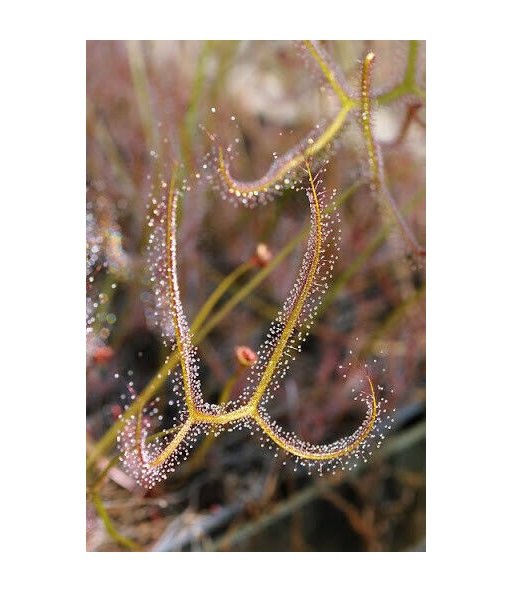
Sundew binata var. dichotoma is an easy plant to grow. It measures 25cm in height with 4 fork traps, its flower is white.
Sundew binata var. dichotoma is a species whose area of distribution extends in eastern Australia from eastern Queensland to the south-east of the state of South Australia, to which must be added Tasmania and the New Zealand. This species is found in a variety of permanently wet, acidic soils, from highland bogs to coastal marshes.
The adult plant consists of a rosette of leaves with a fairly long (up to 25 cm) narrow and flattened erect petiole, at the end of which the blade immediately divides into two narrow leaflets, each bearing a bifurcation at the level of their first third. The four ends ending in points (up to 30cm wide).
The glandular cilia, very numerous, are long on the edges and at the extremities of the blade, shorter and tight on the top of the blade, and absent on the rest of the plant. The cilia fold over prey, but the leaflets are not very mobile on adult plants. Eyelashes redden under strong light.
The digestive glands are located on the upper surface of the lamina. The roots are few, very sparsely divided, fleshy and black, except at the tip, which is light. They can be as deep as the plant is tall.
The floral stems, normally emitted in spring or at the beginning of summer, start from the center of the rosette, and are clearly higher than the leaves. They are generally bifid (even sometimes more divided) and the flowers are distributed fairly evenly around the short branches. The flowers are simple, with radial symmetry of order 5 in general (sometimes from 3 to 6), the petals, filaments and style are white, the stamens yellow. With a diameter of about 3.5cm, they only open for one day, and are not self-fertile. Once the flowering is over, the stalk turns black and releases many black seeds, about 1mm long and very fine.
SHIPPING is 5 to 8 weeks
Package Contain 40 Seeds (approx.)
Sundew binata var. dichotoma is a species whose area of distribution extends in eastern Australia from eastern Queensland to the south-east of the state of South Australia, to which must be added Tasmania and the New Zealand. This species is found in a variety of permanently wet, acidic soils, from highland bogs to coastal marshes.
The adult plant consists of a rosette of leaves with a fairly long (up to 25 cm) narrow and flattened erect petiole, at the end of which the blade immediately divides into two narrow leaflets, each bearing a bifurcation at the level of their first third. The four ends ending in points (up to 30cm wide).
The glandular cilia, very numerous, are long on the edges and at the extremities of the blade, shorter and tight on the top of the blade, and absent on the rest of the plant. The cilia fold over prey, but the leaflets are not very mobile on adult plants. Eyelashes redden under strong light.
The digestive glands are located on the upper surface of the lamina. The roots are few, very sparsely divided, fleshy and black, except at the tip, which is light. They can be as deep as the plant is tall.
The floral stems, normally emitted in spring or at the beginning of summer, start from the center of the rosette, and are clearly higher than the leaves. They are generally bifid (even sometimes more divided) and the flowers are distributed fairly evenly around the short branches. The flowers are simple, with radial symmetry of order 5 in general (sometimes from 3 to 6), the petals, filaments and style are white, the stamens yellow. With a diameter of about 3.5cm, they only open for one day, and are not self-fertile. Once the flowering is over, the stalk turns black and releases many black seeds, about 1mm long and very fine.
SHIPPING is 5 to 8 weeks
Package Contain 40 Seeds (approx.)


 ID, Maluku